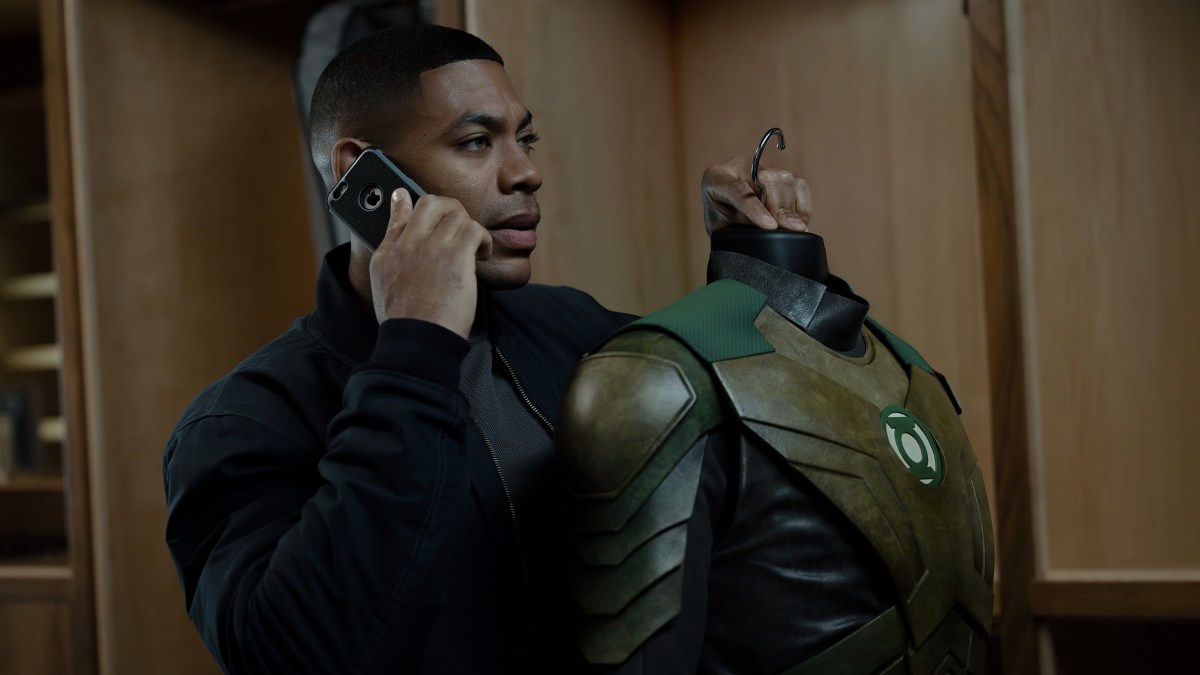
Before introducing himself, Hal stands on a rooftop and watches John intercede when a pair of police officers hassle some Black men playing dominos on the sidewalk. John’s cocky attitude offends Hal, who pleads with the Guardians one last time to reconsider their choice. When they refuse, Hal begins training John, and his discomfort only grows. John almost immediately proves himself capable of wielding the ring, but he also refuses to wear a mask, he takes “the superhero gig” for “laughs,” and hesitates while rescuing a racist senator and presidential hopeful from an assassination attempt, making a blackface joke when the hate-monger gets doused with oil.
Stewart has a few more appearances around the DC Universe, but it’s Len Wein who upped John’s status. When Wein became the main writer on Green Lantern, he brought John up to the big leagues, making him Earth’s full-time Lantern in issue #185 (1985), penciled by Dave Gibbons. Wein, and especially his successor Steve Englehart, developed John into a three-dimensional character, keeping his passion for social justice but allowing him to be a full person, not just a loud caricature. Under their tenure, John became fully integrated into the DC Universe, even serving on the Justice League of America… a tenure that does not go well for him.
John Stewart’s Odyssey
The first major change in John’s personality comes shortly thereafter, in one of the clunkiest stories in the character’s history. In 1988, DC published Cosmic Odyssey, an event comic written by Jim Starlin and penciled by Mike Mignola.
In this New Gods-focused four-part story, the Justice League fights against a universe-ending threat, splitting into groups to save various planets. John and Martian Manhunter get sent to Xanshi to fight off an attack, which includes a bomb at the center of the planet. Full of himself, John captures Martian Manhunter in a bubble and sends John away to defuse the bomb himself. But when he finds it, John discovers that the bomb is yellow—the one weakness of a Green Lantern ring at the time—and the planet explodes.
John has been written as a braggart, but that was out of character, even for the time (rumor has it that Starlin mixed up John Stewart with Guy Gardner, and somehow it got past editorial). Yet, it gave John pathos, especially when the Green Lantern Corps was destroyed by Sinestro at the end of Englehart’s run that same year, leaving only a few Lanterns in the entire universe. During that period, the supervillain Star Sapphire murdered John Stewart’s wife and fellow Lantern Katma Tui in a story published in 1988’s Action Comics #601, by Christopher Priest and Gil Kane, leaving him utterly devastated.
Thus, when the disgraced writer Gerard Jones started writing a relaunched Green Lantern book in 1990, he had a broken, disillusioned John to work with. Jones used that guilt to continue building on John throughout Green Lantern, and especially in the spinoff series Green Lantern: Mosaic, drawn by Cully Hamner, which ran 18 issues from 1992 to 1993. That series followed Stewart as he tried to protect a planet comprised of cities from alien worlds (and one from West Virginia, foreshadowing Lanterns‘s depiction of Rushville, Nebraska). Jones portrayed John as a mosaic himself, deeply introverted and insecure about where he belonged. For every time he asserted himself, whether that be telling off the Guardians or Jordan, John fell back into a period of introspection and questioning.