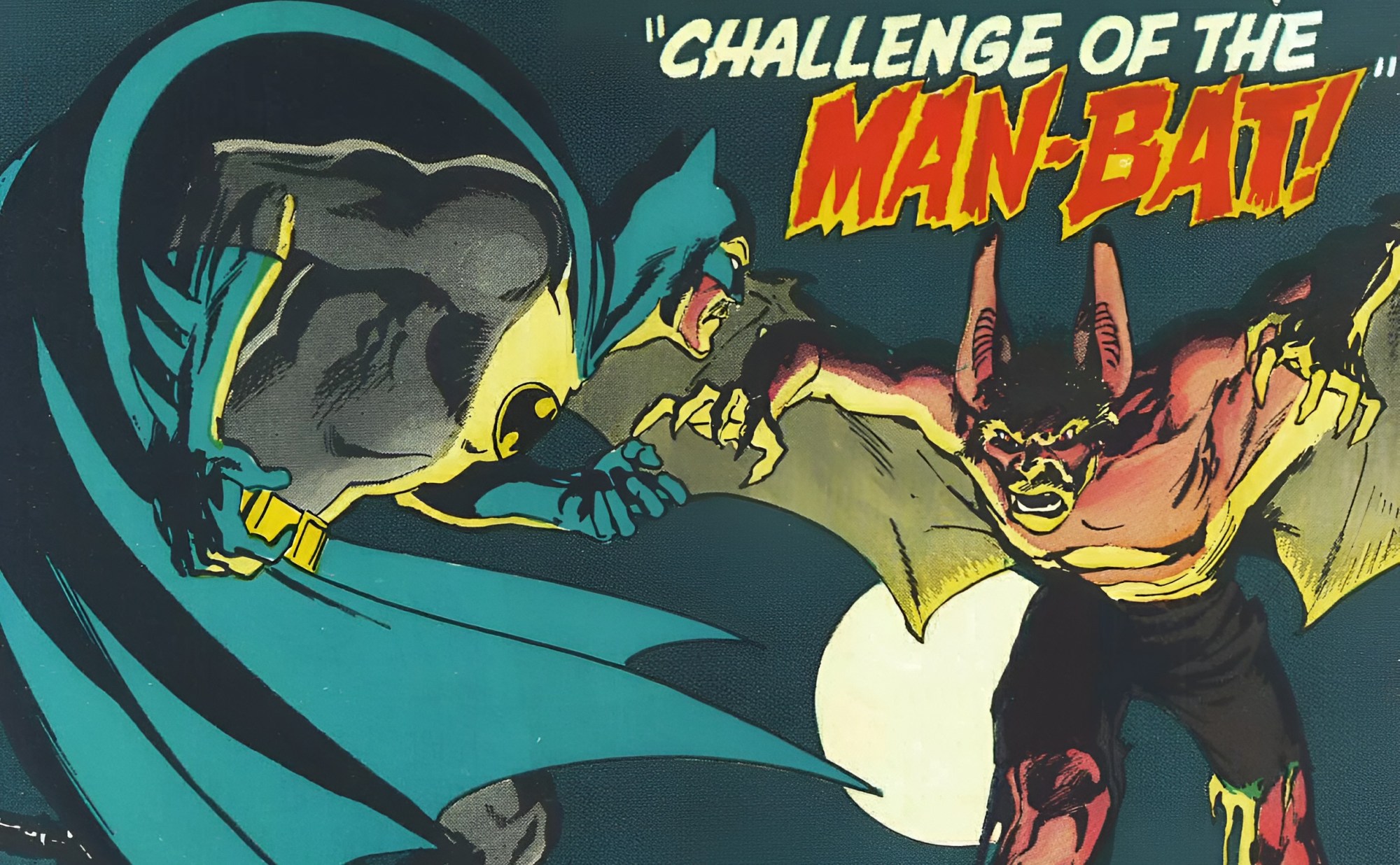
There are only two real answers to the question of “which super-hero has the best bad guys?”, and down to Spider-Man and Batman. The greatest advantage Batman has is history, boasting another twenty-odd years of comic books to help build out his iconic rogues’ gallery. Many of Batman’s foes date back almost as far as the hero himself, though later writers and artists have made their mark with the likes of Bane, Harley Quinn, and Poison Ivy. Each era’s new opponents are a reflection of the times, both for the Batman character and for the comic book medium. In that respect, few Batman villains are more emblematic of their era than Man-Bat, an idea pitched by editor Julius Schwartz and brought to life by Frank Robbins and Neal Adams, part of an effort to bring Batman back to his dark, horror-tinged roots. In the decades since, the character has become a fan favorite, a unique and terrifying addition to the casefiles of the World’s Greatest Detective.
Man-Bat debuted in 1970’s Detective Comics #400, part of a character-redefining era for the book and its sister title Batman that sought to shake Batman free of his camp image. Writers like Robbins and Denny O’Neil sought a more grounded tone for their stories, elevated by the moody, evocative pencils of artists like Adams and Jim Aparo. Today, the early seventies are upheld by Batman fans and collectors as the pinnacle of the character’s comic book adventures, and are priced accordingly. Classic issues like the debut of Ra’s al Ghul or Neal Adams’ stunning “Demon of Gothos Mansion” cover are among the most expensive comics of the Bronze Age in any condition, as is Detective Comics #400. This week, Heritage Auctions is selling an almost perfect copy: a CGC (Certified Guarantee Company)-graded 9.8 Near Mint, one of just twelve in its condition in the world, with none in better condition.
How Man-Bat Became One of Batman’s Most Enduring Bronze Age Villains
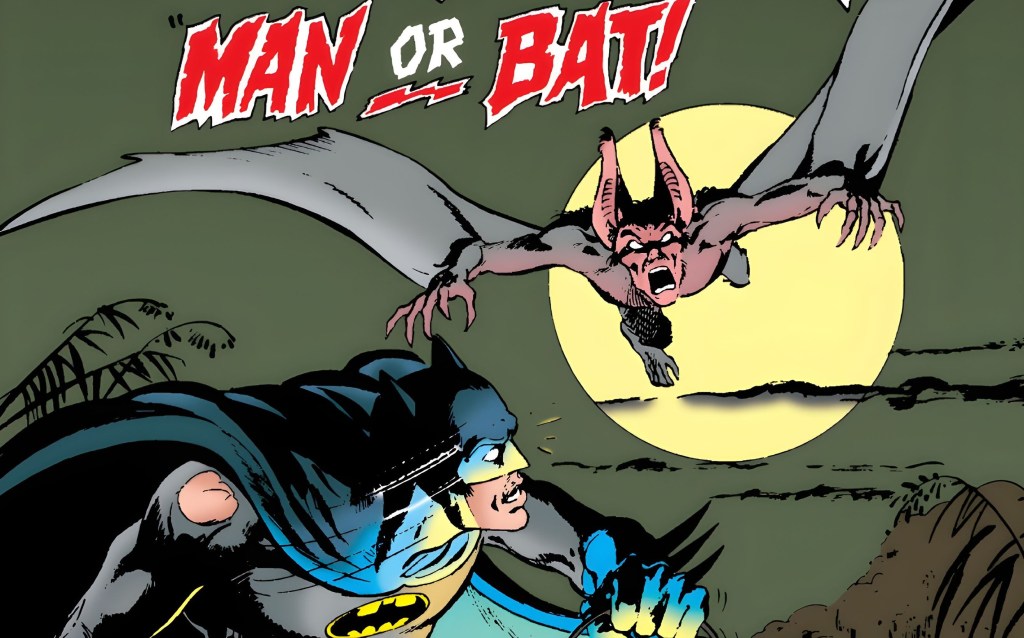
Conceptually, Man-Bat was pretty obvious, both from the standpoint of his name and the Jekyll-Hyde-esque characterization. He also bears a more-than-passing resemblance in concept to Marvel’s Lizard, although that sort of thing happened often in the early seventies. Like Lizard, writers seemed divided on what direction to take Man-Bat, whose alter ego of Kirk Langstrom oscillated between an empathetic, tragic figure and an archetypal mad scientist. In Robbins’ and Adams’ inaugural “Man-Bat Trilogy” (Detective Comics #400, 402, 407), Langstrom is an ardent admirer of the Caped Crusader, experimenting with bat-glands in an effort to create a serum that will give him the same powers and abilities as his hero. During their first encounter, Batman and Man-Bat meet as allies, defending the Gotham Natural History Museum from the thieves known as “the Blackout Gang.” Man-Bat is forced into conflict with Batman in Detective #402 after Batman tries to stop Man-Bat from stealing chemicals vital to reversing his transformation.
It’s in Detective #402 that Langstrom begins to lose control over his mutated form, developing more and more bat-like characteristics (this is the issue where, despite the cover of his first appearance, Man-Bat sprouts wings). Batman takes Man-Bat to the Batcave to try and devise a cure on his own, but Man-Bat escapes in Detective #407. Batman tracks Man-Bat to a cathedral, where his wedding to Francine Lee is underway, a disguise affixed to his head to hide his metamorphosed features. Batman tears the disguise from Langstrom, revealing the form of the Man-Bat to Francine, but she has a surprise of her own. Tearing away the bridal veil, Francine Lee reveals to Batman that she has dosed herself with the Man-Bat formula, becoming the She-Bat! Batman battles Man-Bat and She-Bat, defeating them by ringing the cathedral bells and turning their hyper-sensitive hearing against them.
Though Batman develops a serum to reverse Man-Bat and She-Bat’s transformation, its effects are short-lived, and Man-Bat returns in Detective Comics #416. In this issue, Kirk and Francine Langstrom are finally married, with Batman serving as the best man. Man-Bat returns after a psychotic episode inspires Kirk to recreate and readminister himself with the Man-Bat serum, forcing Batman to cure him again. Francine would become She-Bat again in Detective Comics #429, her latent bat-genes reawakened after being bitten by a radioactive bat in New Mexico. Subsequently, Kirk voluntarily transformed himself into Man-Bat once again to fight crime, even briefly starring in his own comic (1975’s Man-Bat, which lasted two issues). Following its cancellation, Man-Bat became a regular back-up feature first in Detective Comics, and then in Batman Family (the then-top selling Batman title). This super-heroic depiction of Man-Bat would last into the early eighties, even teaming with Superman in an issue of DC Comics Presents.
Gerry Conway returned Man-Bat to villainy in Batman #341-342, where Langstrom accidentally transforms himself into a savage, bestial Man-Bat following an overdose of the Man-Bat serum. Taking up residence in the abandoned Batcave, Man-Bat would be mistaken for a ghost haunting Wayne Manor. Discovering the truth, Batman (and an unwitting Doctor Thirteen, “Ghost-Breaker” and rival of the Phantom Stranger) was drawn into conflict once again with Man-Bat, this time failing to cure his former friend. The demented Man-Bat would return to kidnap Batman’s ward, Jason Todd (the much-maligned second Robin), forcing him into his final pre-Crisis on Infinite Earths battle with Batman. He is cured once again at the close of Batman #361, though he returns as Man-Bat in the pages of 1985’s Blue Devil Annual #1, a cross-over story featuring many of DC’s super-natural heroes. Here, Felix Faust forces Langstrom back into the form of Man-Bat to do his bidding, though Man-Bat ultimately joins the issue’s proto-Justice League Dark of supernatural heroes to defeat him. Outside of an eight-page back-up in 1988’s Action Comics #600, Man-Bat did not appear again until 1994.
Why Man-Bat’s Comic Appearances Aren’t the First Thing Most Fans Think Of
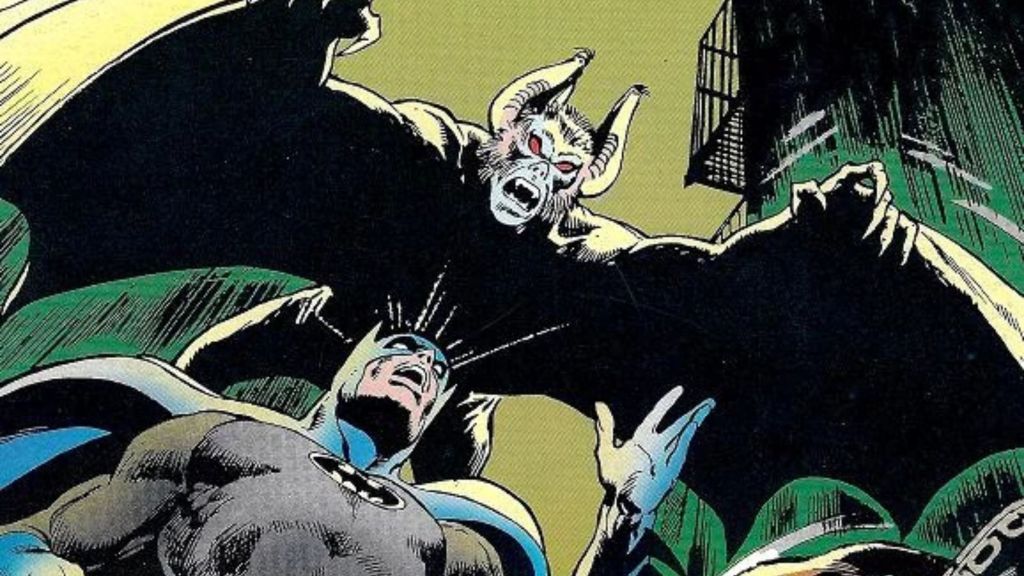
During his six-year break from the comics, Man-Bat received a surprising honor, serving as the first-ever villain to appear in 1992’s Batman: The Animated Series, and technically the first-ever DC character featured in the iconic DC Animated Universe. Co-creator Bruce Timm explained in an interview that Man-Bat was a calculated choice on the showrunners’ part: “Man-Bat was chosen specifically because he wasn’t familiar to very many people outside comic-book fans. Nobody had any preconceived notions about him …. It was kind of like our manifesto. The episode was designed to show you what the show was going to be about. It’s not about – even though we were eventually going to do that too – the wacky Joker or the silly Penguin; it’s dark, it’s spooky, it’s mysterious.”
Timm’s comments on Man-Bat are emblematic of his place in the Batman mythos: he’s the definition of a fan favorite, used by those fans to recognize fellow dedicated Batman fans and readers. Man-Bat also represents a different side of Batman’s world than many of his other foes, functioning as a less-grounded but more mortal, physical threat. A battle with Man-Bat forces a different kind of thinking from Batman, it challenges him differently than matching wits with the Riddler or Catwoman. The makers of the Arkham franchise knew this, giving Man-Bat his other most memorable media exposure through a terrifying storyline in Batman: Arkham Knight. As anyone who has played can testify, the Man-Bat questline enables Arkham Knight a sudden pivot into an outright horror game, just as unnerving as Adams’ pencils or Timm and his team’s animation.
In 2021, a world record price was set for Man-Bat’s first appearance when Heritage Auctions sold a 9.8 graded copy for $43.2k. In the five years since, comic prices have only continued to soar, with records constantly being smashed for “blue chip” key issues like this one. Though the sample currently on auction at Heritage has a long way to climb before breaking that $43k record, market conditions make it look entirely possible. After all, James Gunn is on record as saying he’d be “disappointed if we never see MB in the DCU,” making the character’s flight into live-action look like it may finally be on the horizon. With Clayface poised to hit theaters next month, the tragic Dr. Jekyll and Mr. Hyde story of Kirk Langstrom might just make for the perfect follow-up, and it might just make his already-prized first appearance that much more valuable to fans and collectors.