The legendary music publicist, bestselling author, and independent scientific thinker has built one of the most unconventional careers in modern intellectual life.
What connects Michael Jackson, Albert Einstein, the origins of the universe, and the mysterious psychology of human crowds?
One answer is Howard Bloom.

Few figures have traveled such an unusual professional and intellectual path. Once a central player in the powerful machinery of the music industry, Bloom eventually emerged as an author and scientific thinker fascinated by the hidden forces driving human civilization.
His story is not about abandoning one career to pursue another. It is about discovering that seemingly unrelated experiences can reveal surprisingly similar patterns.
A Scientist Before the Spotlight
Long before the entertainment industry knew his name, Howard Bloom was a young man captivated by scientific discovery.
Growing up in Buffalo, New York, he became interested in physics, mathematics, and the origins of the cosmos while other children were occupied with more ordinary pursuits.
As a teenager, he experimented with computers and mathematical machines, earned recognition at science fairs, and became involved with immunological research.
He has described developing ideas about the universe’s evolution at a remarkably young age, believing some of his early thinking anticipated concepts that later became important in cosmology.
Whether investigating the behavior of cells or considering the structure of the universe, Bloom was searching for patterns that could explain how complicated systems emerge and evolve.
It was a question that would eventually follow him into one of the world’s most glamorous industries.
Inside the Machinery of Rock & Roll
By the mid-1970s, Bloom had established himself in music journalism and public relations.
In 1976, he launched The Howard Bloom Organization, which became a major force in music publicity.
His roster and professional associations read like a history of modern popular music.
Michael Jackson. Prince. Bob Marley. Billy Joel. Cyndi Lauper. Talking Heads. Lionel Richie. Bette Midler. AC/DC. Run-DMC.
These were artists capable of commanding enormous audiences and influencing popular culture far beyond their recordings.
Bloom understood the importance of publicity, but his fascination extended beneath the surface of celebrity.
He wanted to know what made audiences respond so powerfully to performers.
What caused fans to identify with people they had never personally met? Why did music become the defining language of entire generations? How could individuals trigger collective emotional experiences affecting millions?
For Bloom, these questions connected entertainment to a much larger study of humanity.

The Books That Changed His Direction
When chronic fatigue syndrome disrupted Bloom’s career in 1988, he entered an extended period of physical isolation.
His professional circumstances changed, but his determination to examine the forces behind human behavior remained.
The result was a remarkable second chapter.
In 1995, Bloom published The Lucifer Principle, a work examining competition, collective behavior, and the darker dimensions of group identity.
The book challenged readers to reconsider the relationship between biology, society, and history.
Five years later, Global Brain extended his exploration of networks and collective intelligence across the history of life on Earth.
Additional books followed, including The Genius of the Beast, The God Problem, and The Muhammad Code.
Rather than approaching economics, religion, history, or civilization as isolated disciplines, Bloom sought connections between them.
His work became an ongoing investigation into what he calls mass behavior: the ways individuals become part of larger systems capable of extraordinary creativity, cooperation, competition, and destruction.
When Einstein Meets Michael Jackson
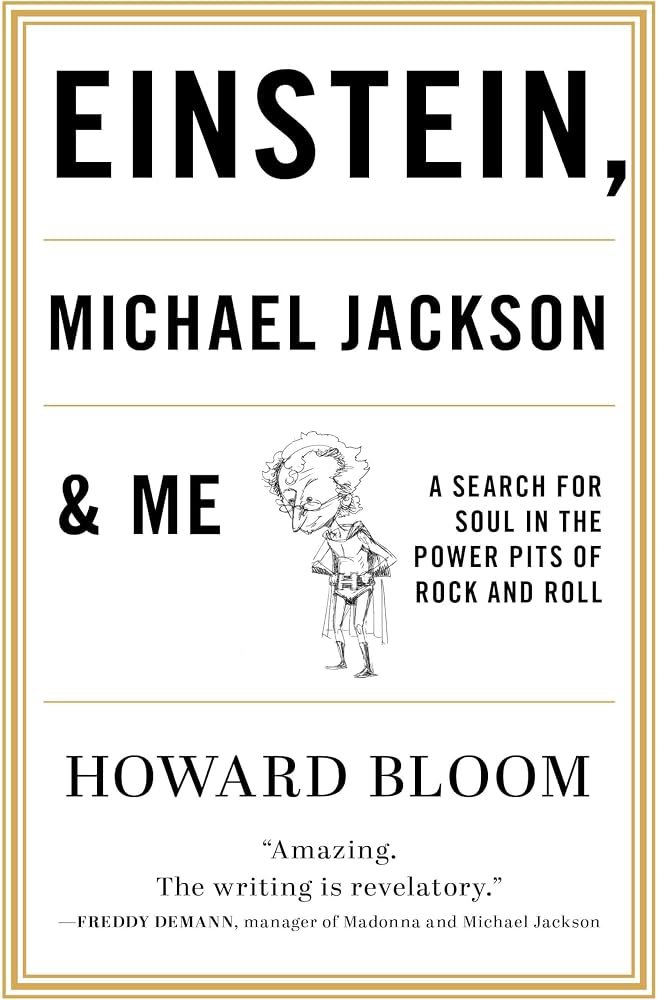
Perhaps no title captures Bloom’s unconventional life more effectively than Einstein, Michael Jackson & Me: A Search for Soul in the Power Pits of Rock & Roll.
Published in 2020 with a foreword by rock legend Joan Jett, the book draws on Bloom’s experiences within the music industry to examine creativity, ambition, group psychology, and the strange emotional machinery of fame.
It is also a reminder that history’s cultural icons can offer insights into human behavior every bit as fascinating as those found in traditional academic settings.
For Bloom, a packed concert arena was more than entertainment.
It was a vivid demonstration of individuals becoming emotionally synchronized through a shared experience.
That fascination helps explain why his career has repeatedly crossed boundaries between disciplines.
Looking Beyond Earth
Bloom’s interests have also extended into space exploration and humanity’s long-term future.
He has served on the National Space Society’s Board of Governors and helped establish the Space Development Steering Committee in 2006.
His involvement with scientific and space advocacy organizations reflects a conviction that humanity’s story cannot be fully understood without considering its place in the wider universe.
He has also been a visiting scholar at New York University and founded the International Paleopsychology Project, bringing together researchers interested in ambitious questions about evolution and behavior.
Throughout these endeavors, Bloom has demonstrated a willingness to challenge assumptions and explore ideas outside conventional academic boundaries.
A Mind That Never Stops Asking Questions
Howard Bloom’s life would be remarkable even if it consisted only of his contributions to popular music.
His subsequent work as an author, theorist, and scientific advocate makes his story considerably more unusual.
He has moved between the worlds of celebrity and scholarship, public relations and evolutionary theory, psychology and cosmology, with an intellectual curiosity that continues to define his work.
Some of his ideas are provocative. Others remain subjects of disagreement. But the scale of his questions is undeniable.

What makes societies powerful? How do shared beliefs shape civilization? Why does nature create ever more complex forms of organization? And what might humanity become next?
These are the questions that have occupied Howard Bloom since childhood.
From the backstage corridors of rock & roll to debates about the future of the universe, Bloom has built a career around seeing connections where others see separate worlds.
His greatest contribution may ultimately be his insistence that understanding humanity requires looking beyond the obvious.
To learn more about Howard Bloom, his books, scientific theories, and extraordinary career, visit his official website: https://www.howardbloom.net