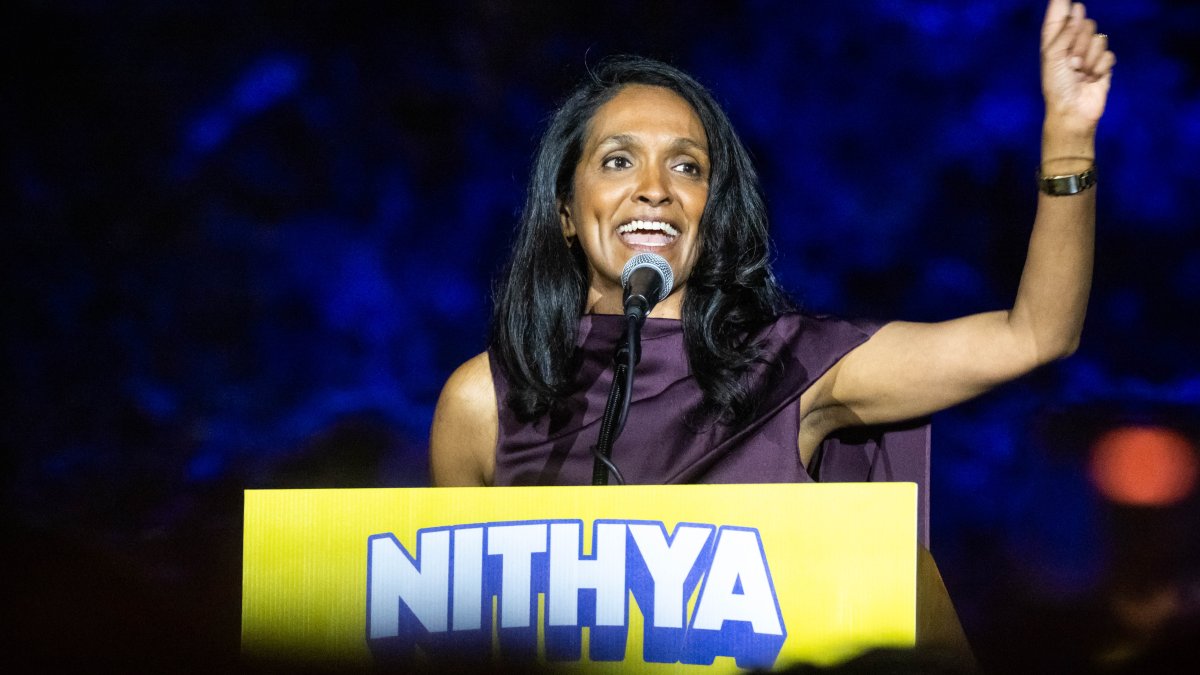
Next month, Nithya Raman will be sworn in as the 44th mayor of the city of Los Angeles following months of a hard-fought, sometimes brutal campaign.
Her plans for the city must have resonated with more than 481,000 Angelenos who had voted for her as of Friday, with nearly 80% of the expected votes counted. Many of her proposals, ranging from ending homelessness to boosting LA’s nightlife, appear to focus on making greater use of existing resources and improving fiscal efficiency.
For the 426,000 people who voted for Bass or opted out of voting this year, the next four years will offer a chance to determine whether Raman’s plans affect their quality of life.
Here are the courses of action the mayor-elect laid out as a candidate.
Raman proposes expanded health services, shorter motel stays to address homelessness
Ending homelessness was at the core of Raman’s campaign, as she repeatedly highlighted that her City Council district saw a nearly 50% drop in homelessness under her watch.
During the campaign, Raman criticized outgoing Mayor Karen Bass’ Inside Safe program as too costly and ineffective, arguing that it lacked a long-term plan for unhoused people.
- Street medicine: According to Raman’s campaign website, her administration will expand street medicine teams to provide health services to unhoused people, including mental health and substance use services. And because nearly 60% of them are covered by Medi-Cal, it would cost $200 a month to treat each patient, according to Raman. The total cost of providing health services to 7,700 people living on the streets of Los Angeles would amount to $18.5 million. (In fiscal year 2025-26, the city allocated $1.97 million for street medicine services.)
- Limits on hotel/motel stays: Under Bass’ Inside Safe program, unhoused people are offered hotel or motel rooms, which cost the city more than $44 million between July 2024 and June 2025. Raman told voters that the Bass administration was spending too much by allowing unhoused people to stay in hotels and motels for more than a year. That’s why, according to her website, Raman wants to limit hotel and motel stays to 120 days. Participants would then be moved into housing and given up to 24 months of rental subsidies, in addition to case management to help them build income and address health needs.
- Rapid response: Raman also pledged to make it “easy” for residents, workers and business owners to report a homeless tent in their neighborhood. Under Raman’s plan, an outreach worker would respond within 48 hours and begin providing assistance.
- Audit: Raman said she wants to audit every dollar spent on homelessness on her first day in office and that she has the support of LA City Controller Kenneth Mejia, who endorsed her for mayor.
In total, Raman’s audacious anti-homelessness plan would cost the city’s general fund about $98 million for the first three years of her term then $49 million in the fourth year.
Proposal to enhance public safety with unarmed response
Raman, who once supported the “defund the police” platform promoted by the Democratic Socialists of America, said unarmed response officials would be dispatched to neighborhoods across Los Angeles and incorporated into the 911 dispatch system.
The mayor-elect has said she does not want LAPD staffing to decline, but wants to reduce officers’ workloads by expanding unarmed response teams to handle certain nonviolent calls.
She said she would work with the LAPD to ensure officers respond to emergency and public safety calls in a timely manner. However, her campaign has stopped short of explaining how the city would fund the expanded operations.
On nuisance properties that pose “immediate fire, health or public-safety risks,” Raman said she would push for “urgent abatement upfront.”
Putting limits on liablity costs
Naming the LAPD as the city’s “largest source of liability payouts,” Raman said she would push for reforms affecting city employees, including police officers, based on recommendations from City Administrative Officer Matthew Szabo.
The recommendations include holding city departments accountable through centralized liability-risk oversight and offering financial incentives for reducing liability risks.
Under Raman’s proposal, the LAPD could be required to use its own budget to cover liability payouts rather than relying on the city’s General Fund.
The city spent about $150 million settling lawsuits involving the LAPD in fiscal year 2025-26. Among those payouts was $14.6 million awarded to four LAPD officers who sued the city, alleging they were retaliated against for reporting staffing shortages.
Strengthening anti-ICE stance while protecting immigrant communities
Raman, who has said the LAPD has been cooperating with the Trump administration and the Department of Homeland Security, wants to prohibit the police department from working with U.S. Immigration and Customs Enforcement (ICE).
California’s sanctuary law already restricts state and local law enforcement agencies from cooperating with federal civil immigration enforcement, subject to certain exceptions.
The mayor-elect also said she wants to ban ICE operations on all city properties. Her predecessor, Karen Bass, has already codified an executive order prohibiting federal immigration agents from conducting immigration enforcement activities on city property.
Raman said she would fully staff the existing Office of Immigrant Affairs, equipping it with the personnel and infrastructure needed to provide services. She also wants to expand the city’s investment in RepresentLA, a program that provides free deportation defense and legal representation to immigrants.
She also proposed creating an emergency utility-fee waiver for families affected by federal immigration raids.