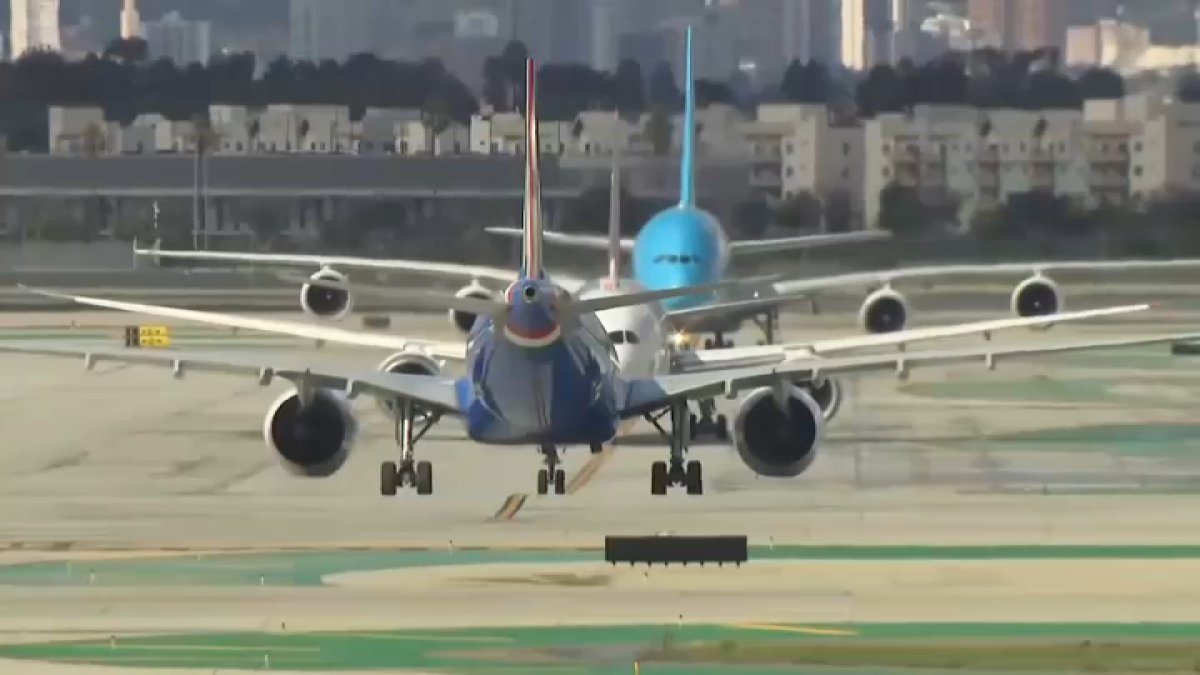
U.S. air travel is expected to be close to normal by late Sunday after a weekend of flight delays and cancellations frustrated travelers, triggered by a roughly four-hour nationwide ground stop for all air traffic by federal aviation officials.
As of late Sunday morning, the tracking website FlightAware was reporting 17,670 delayed flights and 2,218 canceled flights across the country, including 246 delays and 73 cancellations at LAX. Orange County’s John Wayne Airport had 49 delays and 16 cancellations, Hollywood/Burbank Airport had 36 delays and 11 cancellations, and Long Beach Airport had 23 delays and one cancellation.
Officials at all airports were continuing to advise travelers to reach out to their respective airlines for information about specific flights.
The Federal Aviation Administration issued the nationwide ground stop Friday shortly after 1 p.m. Pacific Standard Time because of a communications issue affecting all 22 Air Route Traffic Control Centers, including the center in Palmdale, officials said.
The order required all departing aircraft to remain on the ground while technicians investigated the problem. Flights already in the air continued to land, while inbound international flights were to be handled on a case-by-case basis.
The ground stop was lifted at about 5:30 p.m. Friday, but widespread delays and cancellations have continued.
U.S. Transportation Secretary Sean Duffy said Friday night at the White House that aging air traffic control equipment and data-overloaded routers triggered the disruption.
“What we have is an incredibly old air traffic control system,” Duffy said at an earlier news conference. “Our routers actually got overloaded with data.”
Duffy said the routers began providing inconsistent data, prompting the FAA to shut down the system as a safety precaution. He said some routers had been replaced, but older hardware failed.
On Saturday, Duffy elaborated on the cause of the problem.
“In at least one of our remote FAA locations, a contractor was doing routine maintenance to switch telecommunication lines from old copper wire, and they were bringing it over to fiber,” the secretary said. “Either through contractor error or a faulty piece of equipment, that router that was being replaced as we switched from copper to fiber, it started flooding other routers in our air traffic control system. So specifically, we had over 1,000 connection attempts every four to five seconds, and what that did was gave us issues with our communication with airplanes, and it also caused some disruption with our radar feeds.”
On Sunday, Duffy said “we have the router; it’s at the L3Harris lab in Florida with FAA staff. We are doing a full review of the router and the process that was used in El Dorado, Texas. The FBI has offered assistance. President Trump actually had the whole of government on the phone on Friday, (asking) `Has anyone seen footprints? Is anyone hearing chatter? Was this a cyberattack from a foreign nation?’
“We have no indication that that was at play here. We think it was the installation of the router that was the bad actor. But we’re open; if we see something else we’re going to continue to investigate,” he added.
Other administration officials have also insisted there was no indication the technical problems were the work of a cyberattack or AI mishap.
“We see zero evidence of anything nefarious, and zero evidence of anything AI-related. So we want to be clear that we have a equipment issue, and we’re working through what this defective piece of equipment was,” FAA Administrator Bryan Bedford said Saturday.
Homeland Security Secretary Markwayne Mullin also said the disruption was a telecommunications outage and not a national security threat.
The outage occurred one day after the FAA announced an expansion of an artificial intelligence-based flight-management system known as SMART, or Strategic Management of Airspace, Routes and Trajectories. The system, initially used in the Washington, D.C., area, was being expanded to all 22 air traffic control centers to reduce delays, cut fuel consumption and improve the travel experience, according to the FAA.
It was unclear whether the SMART expansion was connected to Friday’s communications problem. Mullin said an investigation would determine whether the system played any role.
Air Space Intelligence, the company that developed and operates the SMART system, said in a post on X that the ground stop was not connected to its technology.
“The current ground stop is not based on or a result of the SMART system, or any product of ASI or our integration with FAA and ATC,” the company said.
The disruption marked only the second nationwide FAA ground stop since the Sept. 11, 2001 terrorist attacks. The last one occurred in 2023, when a pilot notification system failed.