Overnight lane closures are planned this week for work on a wildlife crossing nearing completion over the 101 Freeway in Agoura Hills.
One lane in each direction will be closed, starting overnight Tuesday into Wednesday, between Liberty Canyon Road and ChesebroRoad/Palo Comado Canyon Road for fence installation and soil stabilization, Caltrans said.
Here are the details for early morning travelers.
- One northbound 101 Freeway lane will be closed from 7 p.m. Tuesday to 6 a.m. Wednesday and from 7 p.m. Wednesday to 6 a.m. Thursday.
- One northbound lane will also close from 8 p.m. Friday to 8 a.m. Saturday, from 7 p.m. Saturday to 8 a.m. Sunday and from 7 p.m. Sunday to 6 a.m. Monday, Nov. 30.
- One southbound 101 Freeway lane will be closed from 8 p.m. Tuesday to 6 a.m. Wednesday and from 8 p.m. Wednesday to 6 a.m. Thursday.
- One southbound lane will also close from 8 p.m. Friday to 8 a.m. Saturday, from 8 p.m. Saturday to 9 a.m. Sunday and from 9 p.m. Sunday to 6 a.m. Monday, Caltrans said.
No lane closures were scheduled for Thursday night.
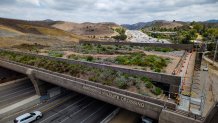
The Wallis Annenberg Wildlife Crossing is scheduled to officially open Dec. 2 over the freeway northwest of Los Angeles. When complete, the project will connecting a natural habitat divided by 10 lanes of busy road.
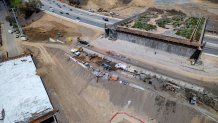
The concrete deck spans the freeway and adjacent Agoura Road, where a section of bridge was recently complete in a milestone for the project. As of early October, crews moved more than 1 million cubic feet of soil.
Construction on the largest bridge of its kind in the world began on Earth Day 2022.
Caltrans
Caltrans A view of the Wallis Annenberg Wildlife Crossing over the 101 Freeway in Agoura Hills.
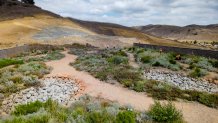
The soil phase of the project included input from scientists, biologists, engineers and mycologists who selected the best soil and fungi for the bridge. The soil is placed in layers, allowing for the addition of about 5,000 native plants that will grow into a habitat for mountain lions, deer, bats, desert cottontails, bobcats, native birds and monarch butterflies, among others.
A live feed of the construction site over the 101 Freeway in Agoura Hills is availablehere.
Why is the 101 Freeway wildlife crossing being built?
It is estimated that the mountain lion population in the Santa Monica Mountains could become extinct within 50 years without an influx of genetic diversity. The lions are largely isolated due to freeways that act as barriers to movement across the region.
Conservationists hope the $85 million crossing will alleviate the problem.
Caltrans
Caltrans A view of the Wallis Annenberg Wildlife Crossing over the 101 Freeway in Agoura Hills.
The star of the fundraising campaign wasmountain lion P-22. Famous for traveling across two freeways and making a huge Los Angeles park his home, the big cat became a symbol of the shrinking genetic diversity of wild animals that must remain all but trapped by sprawling development or risk becoming roadkill.
Vehicles and toxicants, like rat poisons, are two of the biggest threats to mountain lions in Southern California.
Scientists tracking cougars fitted with GPS collars found over decades that roadways are largely confining animals in mountains that run along the Malibu coast and across the middle of LA to Griffith Park, where P-22 settled.
Caltrans
Caltrans A view of the Wallis Annenberg Wildlife Crossing over the 101 Freeway in Agoura Hills.
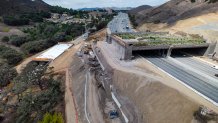
The idea isn’t new, but what makes this project different is that it’s over one of the busiest freeways in the world. The bridge will stretch 200 feet above 10 highway lanes and a feeder road just 35 miles northwest of downtown Los Angeles.
The $90 million price tag will be covered by about 60% private donations, with the rest coming from public funds set aside for conservation purposes. The span will be named the Wallis Annenberg Wildlife Crossing, for the philanthropist whose foundation donated $25 million.
Caltrans
Caltrans A view of the Wallis Annenberg Wildlife Crossing over the 101 Freeway in Agoura Hills.
Wildlife crossings — bridges and tunnels — are common in western Europe and Canada. A famous one in Banff National Park in Alberta spans the Trans-Canada Highway and is frequently used by bears, moose and elk.
The Los Angeles-area bridge has enjoyed nearly universal support, unusual for a public works project. The draft environmental impact document received nearly 9,000 comments — with only 15 opposed, according to the wildlife federation.
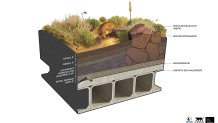
A rendering of the Wallis Annenberg Wildlife Crossing under construction in Agoura Hills. Credit: Rock Design Associates and National Wildlife Federation
There are about 4,000 to 6,000 mountain lions in California, but wildlife officials call that a crude estimate without an ongoing statewide study. More than half of the state is considered prime habitat for the big cats, which can be found wherever deer are present.
The California Department of Fish and Wildlife receives hundreds of mountain lion sighting reports each year. Few result in mountain lions being identified as posing an imminent threat to public safety, the department said. Mountain lion attacks on humans are extremely rare and their nature is to avoid humans.