UPDATE: The explosion has taken place and footage showed a large plume rising from the site of the blast. Live coverage streaming in the player above.
_____________________________________________________________________________________________________________
The U.S. Army plans to detonate the nation’s entire stockpile of lead azide Wednesday morning in Iowa.
The move comes after officials warned the dangerously degrading bomb-making chemicals could otherwise explode at any time.
“Inaction is no longer an option,” said Maj. Gen. Eric Shirley, the Army’s leader of the operation.
It has set off concerns about potential health and environmental impacts from lead dust, and frustration over a lack of information.
So what exactly will happen and when? Here’s what to expect:
What time is the Iowa lead detonation?
The controlled detonation of roughly five tons of degraded lead azide is planned for 9 a.m. CT at the Iowa Army Ammunition Plant in Middletown.
The Army, however, said “a more precise time will be communicated after evaluating changing weather patterns and waiting for the safest possible conditions.”
The blast originally was planned for last Friday. The Army changed the detonation date three times amid public backlash and to allow more time for safety measures and favorable wind, according to court documents.
The Army did not allow media access to the plant “before, during or after” the detonation, but said an update was expected “no later than 11 a.m. CT.”
Where is the largest impact area?
Government officials encouraged residents within 5 miles of the site to evacuate to avoid lead dust in the air, while also assuring them that barriers around the blast zone should limit much of the plume from the detonation.
Officials overseeing the detonation plan say the wind on Wednesday is expected to carry the plume southwest toward Missouri and away from nearby Burlington, a city of just under 25,000 people that sits along the Mississippi River.
See the latest “potential exposure” map from the Army:

The U.S. Department of Agriculture and the Iowa Department of Agriculture estimated there are approximately 350 farms “that could be impacted based on the anticipated direction of the plume for a Wednesday detonation.”
FEMA issued an alert to residents within a 20-mile radius, saying:
“FEMA: Planned, controlled detonation at Iowa Army Ammunition Plant in Middletown Wed, Nov 25 at 9 AM. Some residents within 5 miles SW of the plant may be evacuated. 5 to 20 miles: stay indoors with windows closed to avoid airborne lead dust, noise and vibration. For routes and shelters monitor local media. For evacuation details call FEMA: 1-800-621-3362”
The Army says it must detonate unstable explosives in Iowa, but the planned blast could spread toxic lead dust into nearby communities.
What should you do if you might be impacted?
Evacuations
The Army said the Federal Emergency Management Agency will assist in relocating “all residents of Middletown, Iowa, and immediate surrounding impacted areas” beginning Tuesday.
The evacuation zone was reported to be in “a 5-mile cone southwest” of the Iowa Army Ammunition Plant.
“Out of an abundance of caution, the evacuation extends one mile beyond the dispersion path,” the Army said.
An emergency notification sent to cellphones Tuesday morning said those within that zone “may be evacuated,” but the Centers for Disease Control and Prevention urged residents to either “stay indoors or evacuate if you are in the evacuation zone.”
Those within the evacuation zone will be offered transportation to “safe refuge” for those who cannot travel on their own, as well as shelter, including “short-term hotel lodging” and food, water and other supplies through at least Friday, according to the Army.
“Individuals are encouraged to contact FEMA if greater flexibility is needed,” the Army said in its Tuesday update.
Those who do evacuate will be notified by phone when an all-clear is given for them to return home.
Those with questions or concerns about the evacuation zone are being urged to contact FEMA at (800) 621- 3362.
Shelter-in-place orders
Some residents near Middletown have been sealing their windows and doors as a precaution to keep out any lead dust that might result from the detonation. Others who live farther away were raising concern about the possible paths the plume could take depending on the wind.
The Army recommended those outside the evacuation zone, but in the potential path of the plume to shelter in place.
“Best practices include closing all windows and doors, setting heating to recirculate (heat can stay on), turning off fans that pull in outside air (e.g., bathroom vents and kitchen exhausts), keeping small children and pets inside, and covering feed and water for livestock and crops,” the Army recommended. “Infants and children under 6 years old, pregnant women, and individuals with chronic diseases, such as heart disease, dementia, and chronic kidney disease, may be more sensitive to lead exposure and air pollution.”
Officials have recommended that people clean off outdoor surfaces with water afterward to limit exposure to any lead particles.
Missouri Gov. Mike Kehoe said state agencies are working to establish additional monitoring of air and water quality, public health and agriculture resources.
The Army has set up additional “blast barriers” around the bunkers where the lead azide will be detonated, and to apply ballistic gels and foams to absorb the lead dust.
It also plans to douse the materials with thousands of gallons of water.
“We’ve taken every viable solution and considered it,” Telle said. “In every instance, the answer is controlled detonation is safest.”
Those within the path of the plume are being told to:
- Remain indoors during the potential exposure period if you cannot evacuate beforehand. Keep windows and doors closed.
- If it is safe to do so, set heating and cooling systems to “recirculate” to minimize outdoor air exposure and maximize indoor air filtration until the plume passes by your community.
- Avoid unnecessary travel through affected areas and evacuation zones.
- After officials determine the air exposure period has ended, clean indoor and outdoor surfaces that may be contacted by children.
- In the deposition area, wet-clean surfaces that may be contacted by infants or children, including outdoor play equipment, toys, tables and chairs, handrails, patios, decks, exterior windowsills, and other high-contact surfaces.
What is happening in Iowa?
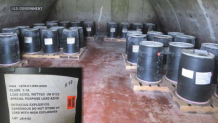
In March, staff at the Iowa Army Ammunition Plant found several dozen barrels of degraded lead azide, which is used in munitions production, had crystalized. The crystallization of the material created an unstable and dangerous situation, prompting the Army to assemble experts in munitions chemistry, engineering and environmental safety to come up with a plan.
“Inspections in April found floating crystals in the drums, mold, and corroded bolts,” according to a report from the Environmental Protection Agency. “The bomb squad (Explosive Ordnance Disposal) team found visible crystal growth in 87% of the barrels and recommended not moving them. Crystallized lead azide is much more sensitive to shock and friction.”
In court filings, Army Col. Aaron Teller, a munitions emergency response specialist, said that less liquid inside the barrels means the solution is more susceptible to freezing, which increases the risk of an explosive chain reaction.
EPA
EPA
According to EPA documents, alternatives to a detonation were considered. But officials said handling the drums would increase the probability of an accidental, fatal blast.
News of the detonation set off concerns about potential health and environmental effects and frustration over a lack of information. Experts have advised that the stockpile will become more volatile as temperatures cool in the coming days.
Environmentalists sued last week to stop the detonation at the site, which is about 90 miles south of Cedar Rapids.
Lead azide is “very sensitive” and also susceptible to heat, freezing, shock, friction and “all sorts of things that could cause an accidental detonation,” said John Goodpaster, a chemistry professor at Indiana University, Indianapolis. It’s also old, which increases the risk because explosives become increasingly unstable as they age, he said.
Add in the environmental threat caused by the lead that will escape into the atmosphere and the challenge is significant, Goodpaster said.
“I do not envy the Army,” Goodpaster said. “They are in a situation where they’ve got a large amount of very dangerous material and not very many good options in terms of trying to dispose of it.”
But it’s impossible to predict when it could explode on its own, he said.
“The longer we wait, the longer the risk accumulates that they might have an accidental explosion,” Goodpaster said.
The Associated Press contributed to this report.