Good versus bad is far from black or white in the not-so-distant future of Blade Runner 2099, where real people and replicants are at odds…yet oddly want the same thing.
“There really are no villains or any heroes,” agrees showrunner Silka Luisa of Prime Video‘s gorgeous sequel miniseries. “It’s all shades of gray. And there were definitely times when I was writing it where I’m very pro-replicant. I’m like, ‘Thank God they took over. They’re trying to improve the air. The world after [Blade Runner 2049] felt like it was dying and they’re birthing it again. They’re birthing it anew.’”
“And then there’s other times where humanity, the warmth of a home, the community, the nostalgia, that’s so emotionally comforting that you don’t want to let that go,” she continues. “And so the hope for the show is that you’re constantly juggling between both sides and you’re not sure which one you want to win out.”

Sara Jaye Weiss
Set half a century after the Ryan Gosling hit, this extension of the franchise, borne of Philip K. Dick’s novel and Ridley Scott‘s visionary 1982 adaptation Blade Runner, flips the power dynamic of what has come before it by putting replicants, the bioengineered humanoids created for slave labor by the Tyrell Corporation, in control and humans under their thumb. Everything Everywhere All at Once Oscar-winner Michelle Yeoh stars as Olwen, a replicant hunting rebel humans for the LAPD’s Blade Runner force, while Hunter Schafer of Euphoria plays her new partner, a human-resistance ally named Cora pretending to be a replicant named Miriam.
And as Silka has stated, it’s tricky to decide who to root for. The series explores the nature of humanity, mortality and memory; it becomes clear that the women aren’t the only ones struggling with doing the wrong thing for the right reasons.
In the series opener, we meet Olwen’s colleague Yaya (House of the Dragon‘s Matthew Needham), an imposing, by-the-book replicant who seems to be secretly looking forward to her looming “retirement” (her line of replicants was created with a limited lifespan). In the same hour, Dimitri Abold‘s Bebeto is introduced as a human civil servant who has been helping Cora acquire fake I.D. so that she can continue to evade the replicants hunting her and her brother Elias (Lewis Gribben of The Damned).
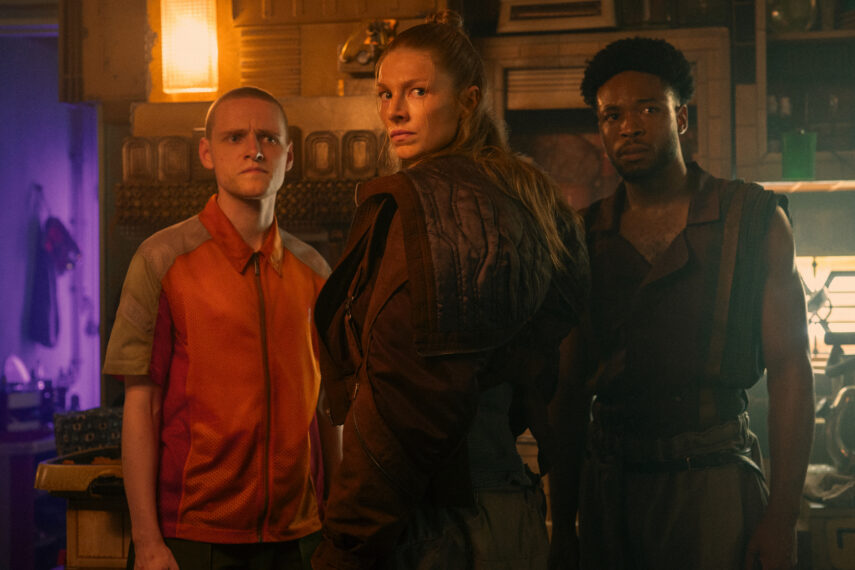
As the episodes roll out, the actions and intentions of these three begin to impact both Cora’s fraught effort to pass as a non-human within Olwen’s world and a developing conspiracy tied directly to the genesis of replicants. Each is driven by an agenda, be it for the love of another, their own personal gain, or the rule of law, and when they eventually intersect, things get interesting.
“We all have really cool scenes together,” Gribben teased when he and his costars sat down with us at New York Comic Con 2026. “There’s a stare down. There’s a nice stare down.”
Here, he and the guys go deep on their characters’ backgrounds and what drives them forward to fight what they think is the good fight between humans and replicants.
Bebeto
Having fought against the replicant uprising, Abold’s war veteran is now working as a civil servant, “but also a black market dealer in our new world of Blade Runner,” he says.
Without giving away too much, he describes Bebeto’s services as “very detail-oriented human augmentation…that allows us to ultimately look a little different than we actually appear.”
“It can be anything from changing one’s eye color to engraving something into somebody’s body to look like something else. We didn’t take it so far as to anything like prosthetics,” he continues. “But things like changing eye colors, for sure. And it’s a gentle procedure. That one is a gentle procedure.” [Warning: There’s another procedure that is the opposite of gentle, as well!]
A hustler determined to free L.A. of replicant control, “he’s born and bred, and he wants to stay. That’s why he’s fighting.” Abold confesses that Bebeto is willing to risk it all even if it means putting himself or someone else in peril.
“Bebeto, just by the nature of what it is that he’s trying to achieve, already knows that he’s going to be in a dangerous situation, period,” he offers. “Even without Cora being involved. Cora is just the next piece in order to make the big step that he needs to have happen.”
Elias
We first hear about Cora’s in-hiding, disabled Elias before he appears on screen, and his first impression is, to put it lightly, explosive.
“[Replicants] have stopped him from having a home. He can’t have a home. He’s often constantly on the run,” previews Gribben of the most volatile of the trio. “And because of his sister having to move all the time, move him all the time, they don’t have anywhere to be themselves, you know what I mean?”
Additionally, he states that the tragic events behind his injury, paired with Cora’s over-protectiveness, have led to a long-simmering strain between the brother and sister that is fueling his anger and activism.
“I think him always feeling like he’s needed to be cared for by Cora because of his disability, he feels like he doesn’t have his own voice,” explains Gribben. “It always has to be what Cora wants, which is always what she thinks is best for him. But he wants to be his own person. So I feel like a lot of that anger comes from just feeling so oppressed and downtrodden in himself, wanting to have that voice and have some sort of action in his life.”
“He wants to show that he is capable of defending himself, of not being crossed with. He doesn’t want to just feel like a pushover his whole life. So I think that’s kind of where that inner drive and determination has come from. And then also just to be hard. I feel like he’s so used to being taken care of that he wants to finally stand on his own two feet at some point.”
Clay Enos/Prime Video
Yaya
The cop you don’t want to mess with. Especially if you’re made of flesh and blood.
“I think he has a deep-seated resentment and hatred for humans,” Needham bluntly notes. “I mean, they enslaved him, and now the roles are reversed, and I think he’s got a lot of animosity and he’s a very, very hostile person.”
And apparently a superior one. “[Replicants,] they’re the next leap forward. They’re the next step for him, anyway. They’re the future. They’re the next evolutionary leap. So I think he just wants to get rid of the past.”
A past that could also include the soon-to-be-retired Olwen. “He just lives in her shadow, doesn’t he?” acknowledges the Sanditon alum. “He’s the junior partner, but he’s a powerful person, and he wants to be in charge, so I think he just wants to break free from her. There’s a begrudging respect, but also there’s a lot of animosity underneath the surface.”
But shouldn’t replicants be emotionless? Needham admits that Yaya’s “insecurities and wants and needs and the desire to win and to defeat evil” could be seen as either “very, very human qualities” and possibly universal views even non-organic creations could exhibit. “I think that’s one of the debates within the show.”
One thing is for sure, though: Cora’s replicant act had better be top-tier around this guy.
“As the show goes on, you can see him; there are certain things which just don’t feel right to him,” Needham hints. “He can’t put his finger on it, but he’s closing in on it.”
Blade Runner 2099, Now Streaming, Prime Video