What to Know
- A magnitude-5.0 earthquake off Manhattan Beach rattled widespread parts of Los Angeles and Orange counties Saturday morning.
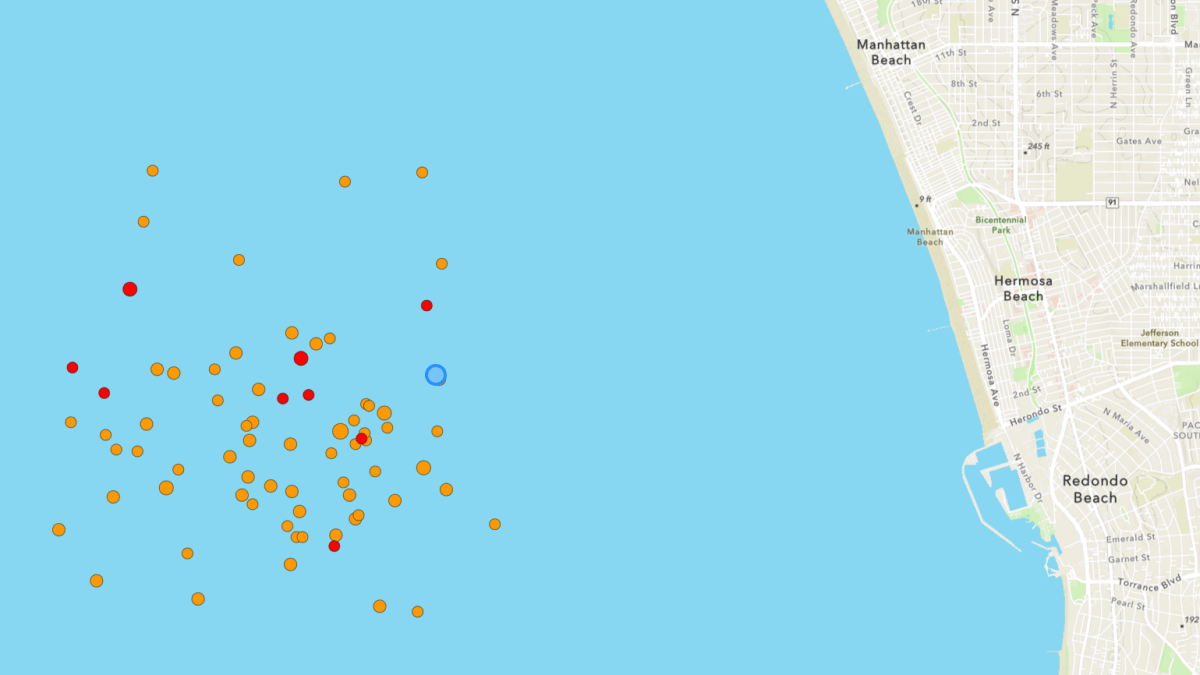
- Dozens of aftershocks followed, many clustered near the main shock.
- Aftershocks decrease over time, but can continue for days, weeks, months and years.
- There is a small chance that the magnitude-5.0 earthquake could be a foreshock, meaning a more powerful quake is yet to come.
Dozens of aftershocks rattled Los Angeles and other parts of Southern California in the first few hours after a magnitude-5.0 earthquake Saturday morning off Manhattan Beach.
The largest aftershock, estimated at 11:41 a.m., jolted the region roughly two hours after the main shock about 3 miles off the coast. As of 2 p.m., more than 50 aftershocks had been reported with more possible in the hours and days ahead.
“It is having quite a few aftershocks,” said seismologist Dr. Lucy Jones. “That’s something that is extremely variable. This one seems to be at least average.”
Aftershocks decrease over time, but can continue for days, weeks, months and even years. Most will occur in the same general area as the main shock.
Most of the earthquakes following the main shock are expected to be less powerful before they, eventually, tail off.
Like any earthquake, the exact time and location of aftershocks cannot be predicted, but the USGS does update an aftershocks forecast. For the Manhattan Beach earthquake, the forecast shows a 41% chance of at least one magnitude-4.0 or greater within the next week. As of 3 p.m. Saturday, two aftershocks of 4.0 or greater had been reported.
The forecast projected a 99% chance of at least one 3.0-magnitude or greater aftershock within the next week. By Saturday afternoon, six magnitude-3.0 or greater aftershocks had been reported.
There is a small chance that the magnitude-5.0 earthquake could be a foreshock, meaning a more powerful quake is yet to come.
“Every earthquake has the potential to be a foreshock,” said Jones. “About 5% of the time it’s followed by something larger in the next three days.
The temblor was registered at 9:31 a.m. at a dept of 10 kilometers, USGS said.
“We have never found something that is discriminant for foreshocks. They don’t look different than any other earthquake.”
For example, the magnitude-9.1 Japan earthquake and tsunami in 2011 was preceded by a magnitude-7.3 foreshock two days earlier.
Shaking has been reported over a widespread area in Los Angeles and Orange counties. Whether people feel shaking from an earthquake largely depends on three major factors — magnitude, distance and local soil conditions.
Magnitude refers to the strength of the quake. The closer the location to the epicenter, the more likely it is people will feel the effects of seismic waves that become less intense as they move out from the fault. Generally, the looser the soil under a location, the greater the amplification.